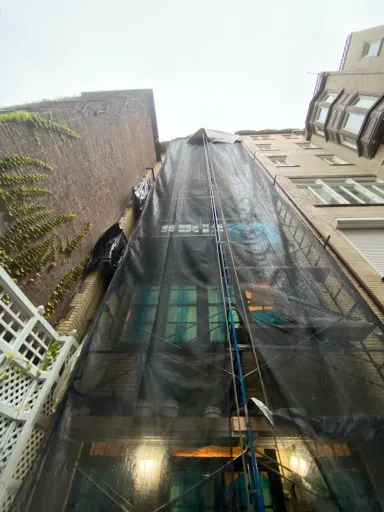
Why brownstone fails, and why most patches make it worse
Brownstone is a soft, iron-rich sandstone that formed in layers, like the pages of a book. On many rowhouse fronts it was set face-bedded, with those layers standing upright parallel to the wall, because that was the cheapest way to cut thin facing slabs. Water soaks in between the layers, freezes, and the face peels away in sheets. That is why a brownstone facade loses its sills, lintel profiles and carved detail first.
The usual fix made it worse. For decades the standard brownstone repair was a skim coat of hard cement stucco, scored to look like stone blocks. Cement is harder and less permeable than brownstone, so water trapped behind it freezes and pushes the coat off in sheets, taking the next layer of stone with it. Sealers and paint do the same thing more slowly: moisture cannot leave the stone, salts crystallize behind the surface, and the face spalls.
Brownstone restoration done properly works with the stone instead of covering it. Failed coatings and delaminated stone come off to a sound surface, and the profile is rebuilt in layers with a restoration mortar matched for color, aggregate and hardness, held by stainless steel anchors. Good brownstone repair is meant to weather with the stone around it, which keeps the next repair small.
Brownstone restoration work our masons perform
Brownstone Facade Restoration
Failed skim coats and delaminated stone are removed to a sound surface, the wall is rebuilt in matched restoration mortar over stainless steel anchors, and sills, quoins and joint lines are recut to the original profiles. Where the damage is local, brownstone facade repair at the spalled areas is the honest scope, and we price it that way.
Stoop Rebuild & Stoop Repair
The stoop takes more water, salt and traffic than any other part of the house. Small losses on treads, risers and cheek walls are patched in a matched mix, failed treads are rebuilt or replaced, and a stoop that has shifted is rebuilt from a sound base. Railing posts are reset so rusting iron stops splitting the stone.
Repointing Brownstone & Brick
Many rowhouses have brick side and rear walls, and brownstone fronts have fine joints of their own. Joints are cut out by hand, never ground wider, and repointed with a mortar softer than the masonry, usually lime-based, so the joint gives way before the stone does.
Lintels, Sills & Window Surrounds
Carved lintels and projecting sills lose their noses and drip edges first, and without a drip, water runs straight down the face. We rebuild profiles from templates taken off surviving pieces, pin repairs to sound stone and restore the drips.
Cornice Repair & Restoration
A loose cornice is a falling hazard before it is a cosmetic problem. Stone cornices are secured, pinned and rebuilt to profile; pressed-metal cornices are fastened back to the wall, repaired and flashed on top, with missing pieces replaced in kind.
Brooklyn Brownstone Contractor
Park Slope, Fort Greene, Clinton Hill, Bedford-Stuyvesant, Prospect Heights, Cobble Hill and Carroll Gardens are lined with brownstone rowhouses, many inside historic districts. As a brownstone contractor in Brooklyn, Manhattan, Queens and the Bronx, we run every job the same way: one crew, a written scope, DOB permits where needed, and sidewalk protection planned before the first stone comes off.
Recent NYC projects
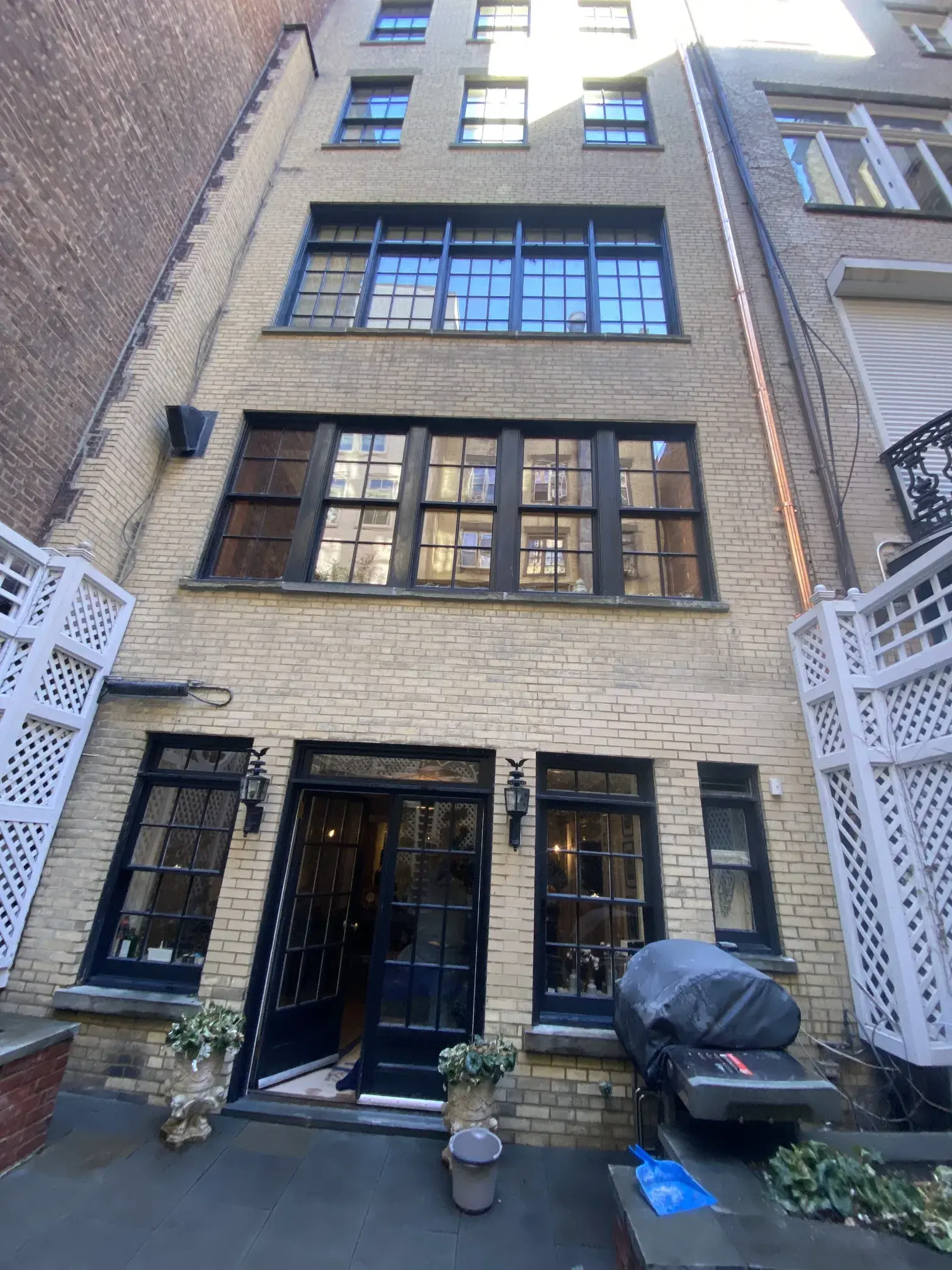


How a brownstone restoration runs, from assessment to close-out
Free brownstone assessment, including a Landmarks check. We inspect the facade, stoop, cornice and joints up close, sound the stone for the hollow and delaminating areas the eye misses, and check whether the building is landmarked or inside a historic district, which decides the paperwork before any work.
Matched test panels. Restoration mortar is mixed to the stone's color, aggregate and hardness and placed as test panels on an inconspicuous spot. Panels are judged after they cure, because brownstone mixes change color as they dry; the approved panel becomes the standard for the job.
Written scope by elevation. Each elevation and element (stoop, lintels, sills, cornice, field stone, joints) is listed with its repair method and quantities. Scaffold, sidewalk protection and permits are priced separately, so you see what the restoration costs and what the access costs.
In-house masons, stainless anchors, layered build-up. Deep repairs get stainless steel pins and wire armatures, mortar is built up in layers rather than packed on in one thick coat, and the surface is tooled to match the stone around it. No sealer goes on at the end.
Close-out photos. You receive before-and-after photos of every repaired element, the mix records for each elevation and care notes, so a future repair can be matched to this one.
What NYC building owners say
Brownstone peeling or stoop crumbling?
Free brownstone assessment in Brooklyn, Manhattan, Queens and the Bronx.
Caring for a restored brownstone
Brownstone lasts when water leaves it quickly, so most of the care is about the top surfaces and the joints.
A restored brownstone facade needs little, as long as the small things are done before a cracked sill becomes a missing one.
Frequently Asked Questions
Restore the stone. Do not cover it.
Matched mixes, stainless anchors and in-house masons: brownstone restoration that weathers with the stone around it.
Related: Stone & Masonry Restoration in NYC