Why flat roofs fail in New York City
Flat roofs aren't actually flat — they're low-slope systems fighting against gravity every day. Water that would shed instantly on a pitched roof sits, pools, and searches for weaknesses in your membrane. Add NYC's temperature swings — summer heat that bakes roofing materials, winter freezes that crack sealants — and you have a system under constant stress.
Most flat roof failures start small. A puncture from rooftop equipment. Seams that separate as the membrane contracts. Flashing that pulls away from parapet walls during thermal cycling. Left unaddressed, these minor breaches become systemic failures that compromise insulation, decking, and eventually the structure below.
Where flat roofs break down
Ponding Water Zones
If water sits longer than 48 hours after rain, your membrane is degrading. We identify drainage deficiencies and address them — adding tapered insulation, improving scuppers, or reworking low spots.
Penetration Flashing
Every pipe, vent, HVAC curb, and rooftop unit is a potential leak source. These details require careful reconstruction with compatible materials and proper lapping sequences.
Parapet Walls & Edge Metal
Coping stones shift. Through-wall flashing deteriorates. Reglet joints open. Perimeter conditions need mechanical attachment and properly detailed tie-ins — not just caulk.
Roof-to-Wall Transitions
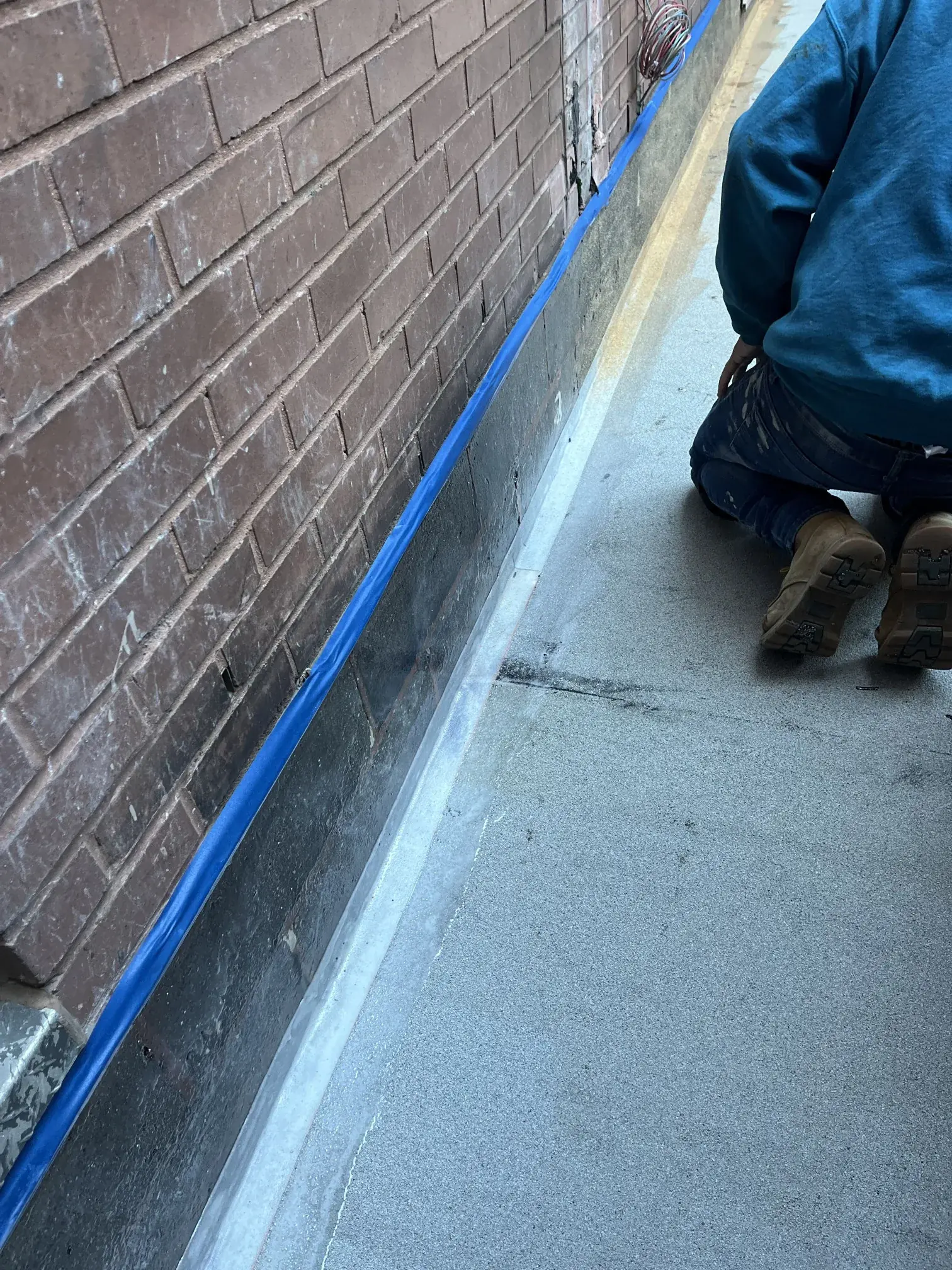
The junction between flat roof and vertical surfaces is a stress point. We rebuild these transitions with base flashing, counterflashing, and proper drainage details.
Modified bitumen and PMMA — repaired right
When we repair modified bitumen, we don't melt patch over problem areas. We cut out failed sections, verify the substrate is dry and sound, and integrate new material using proper overlap and adhesion techniques. Torch application or cold adhesive — the methodology matches your building's requirements and existing system.
PMMA liquid roofing creates a seamless membrane that eliminates the vulnerability of seams entirely. It cures rapidly, even in cold weather, and bonds directly to substrate. For complex geometry — equipment curbs, penetrations, irregular details — liquid systems conform where sheets can't.
Application precision matters more than with any other roofing system. Surface preparation must be meticulous. Thickness must be exact. Substrate moisture must be within tolerances. A rushed PMMA application won't just underperform — it can fail entirely.
Roof leaking? Don't wait.
Free inspection for NYC. No obligation.
Frequently Asked Questions
Precision over speed.
We repair flat roofs the way they were meant to be installed — with the attention to detail that protects your investment for decades, not seasons.